
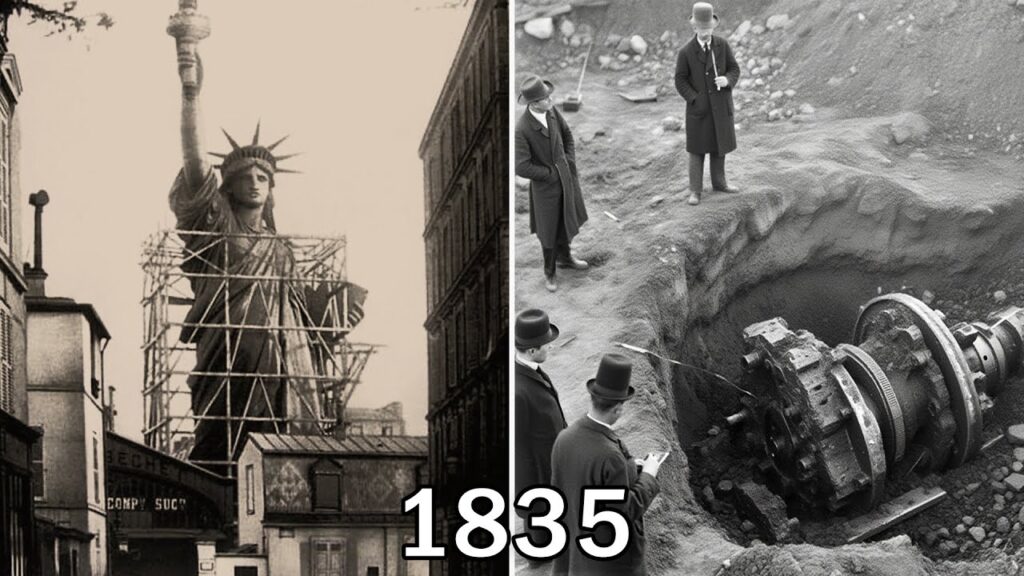
When historians recount the year 1835 in New York, their focus inevitably settles on the catastrophe above ground. The great fire that ravaged lower Manhattan. The 700 buildings consumed in a single December night. The financial district reduced to frozen ash. The city’s heart gutted in temperatures so cold that water turned to ice before it reached the flames. But the authentic narrative, the one conspicuously absent from newspaper accounts and still concealed in archival shadows, originated below the streets. It commenced with a straightforward debris removal operation. Engineers received directives to excavate the burnt district, stabilize foundations across 17 city blocks, and determine whether the scorched earth could bear the weight of a reconstructed commercial center. While the nation watched New York’s merchants salvage what remained of America’s financial capital, the objective was purely practical. clear the wreckage, inspect the substrate, [music] and prepare the ground for rebuilding. But the instant laborers began penetrating through the charred basement, something wholly unanticipated occurred. They breached into chambers that had remained sealed for generations. Below the merchant houses at depths far exceeding any documented sellers’s reach, the teams discovered rooms and apparatus that corresponded to no building registry. Their configuration was bewildering. Their function defied explanation, and the machinery bore no resemblance to anything in the mechanical encyclopedias of that era. It didn’t even echo British industrial engineering as conventionally comprehended. This information never surfaced in public reconstruction reports. It failed to appear in the newspapers chronicling New York’s remarkable recovery. Yet in the confidential documentation of that period, a particular phrase manifests repeatedly. Unforeseen apparatus, unprecedented depth, source indeterminate. The authorized explanation would subsequently compress all of this into antiquated pumping mechanisms, abandoned workshop equipment, or simply misidentified fire debris. Nothing exceptional, nothing warranting scrutiny. But the salvage photographs from that winter, the ones processed in darkened offices while New York reconstructed itself with astonishing velocity, reveal something contradictory. They reveal workers positioned beside metallic enclosures carved with precision far superior to any foundry of that era’s capability. Assemblies fitted so flawlessly that even through the inadequate illumination of 1835 photography, no joinery is discernable. mechanisms and turbines that bear no resemblance to any recognized American manufacturer, but something more ancient, more intricate, more purposeful. And the deeper they excavated, the more the strata ceased resembling industrial chronology as we comprehend it, and increasingly resembled technology that had been interred, obscured, and deliberately expuned from memory. Initially, the recovery crews attempted to categorize everything in the most elementary manner conceivable. Obsolete hydraulic equipment, deserted manufacturing remnants refused from pre-confilgration workshops. But as documentation accumulated and additional machinery was uncovered, the contradictions proliferated. Why were certain mechanisms constructed with specifications far more exacting than any machine facility of the period could accomplish? Why were particular components fashioned in standardized configurations as though mass-roduced rather than individually forged? Why did certain systems extend into chambers far beyond the perimeter of any documented structure? And the inquiry that disturbed even the most seasoned engineers. Why were these machines so remarkably advanced? New York in 1835 was undergoing rapid industrialization. Yet the machinery beneath portions of the incinerated district appeared engineered for applications no contemporary engineer could identify. Recovery teams discreetly acknowledged among themselves that the sophistication and exactitude didn’t align with any known manufacturer. And though none of them employed terminology like vanish technology, they were recognizing something equally unsettling. Someone had constructed these machines previously. Not rudimentary implements, not primitive engines, power generation systems. As the records expanded, so did the quietness. Reports grew more abbreviated. Descriptions turned indefinite. Photographs ceased capturing the most comprehensive perspectives of the discoveries. And then the excavation zones were partially backfilled in early 1836, covered where required for new foundations, and much of what had been exposed was returned to obscurity. Only fragments persist, documentation, a handful of photographs, and the subdued testimonies of archavists who examined the files before some disappeared entirely. But even from what endures, a configuration becomes visible. Machinery excessively precise for any recognized manufacturer. Components excessively advanced for the accepted chronology. Engineering methodologies that appear inherited rather than innovated.
Technology that seems to belong to an entirely different epoch of construction. And this is where contemporary researchers commence posing questions that the 1835 teams could scarcely articulate. Was New York constructed above a forgotten power complex? Were earlier engineers repurposing machinery they didn’t fully comprehend? And why did numerous aspects of the recovery remain undocumented, sealed, or simply eradicated from the records? When the recovery teams advanced past the initial recognizable strata beneath the burnt district, the expectations were elementary. They believed they would encounter basement levels, perhaps some antiquated utility conduits and dispersed remnants from pre-fire construction. Nothing unusual, nothing extraordinary. But within weeks, that presumption shattered because instead of an orderly sequence of basement floors, the teams revealed a succession of technological strata that didn’t behave the way infrastructure of a conventional city is supposed to behave. The initial anomaly was interconnection. Each layer, known basement, unknown subbasements, and whatever existed beneath appeared to adhere to identical energy distribution systems, identical conduit configurations, identical engineering principles. Different eras shouldn’t exhibit that. Different builders, different purposes, different decades. They don’t construct in flawless integration with systems from generations prior. Yet beneath New York, they did. Conduits from one period connected directly to conduits buried meters below them. Energy distribution networks maintained the same trajectory, even when separated by what appeared to be entire building cycles. It was as though every group that ever built on this terrain was connecting to an original infrastructure, one that no longer existed in any engineering archive. As the laborers excavated deeper, the strata grew more peculiar. Below the anticipated basement and foundations, they started encountering machinery that resembled nothing like contemporary equipment. Substantially larger housings, considerably tighter tolerances, configurations that appeared excessively mathematically precise for anything in New York’s documented chronology. Certain mechanisms seemed almost overengineered. rotating assemblies with flawless equilibrium, crafted with precision that didn’t correspond to the crude factories of that period. And then arrived the discovery that confounded even the most conservative members of the engineering teams crystalline chambers, not ordinary storage rooms or utility spaces, but geometric chambers lined with materials that appeared to conduct energy. metal surfaces displaying signs of sustained electromagnetic activity. Lower rooms with what appeared to be resonance amplification systems, housings with crystalline formations that only make logical sense for machinery generating power through means beyond steam or water. Yet there exists no historical documentation of New York ever possessing such power generation before the fire. No records displaying industrial processes requiring this variety of energy management. Nothing that clarifies why substantial sections of the deepest infrastructure appear as though they had once housed technology far beyond any recognized power system of the early 19th century. Recovery photographs captured in 1835 and 1836 demonstrate this unmistakably. Workers positioned beside housing so massive that the men appear miniature by comparison. Components machined so precisely that even today electrical engineers examine the archival images in disbelief. Tolerances and assemblies that resemble contemporary power generation far more than anything 1830s America is attributed with. But the most troubling detail was not what materialized in the photographs. It was what didn’t materialize in the archives. The authorized reports composed in the months following the fire barely reference these characteristics. Certain drawings exclude the deepest chambers entirely. Particular machinery is condensed with imprecise terminology like debris or earlier equipment. Even though the photographs demonstrate it was far more intricate than that. The quietness is difficult to overlook because if these deeper discoveries genuinely belong to recognized historical periods, why weren’t they portrayed in detail? Why weren’t the unusual mechanisms documented comprehensively? Why were the photographs distributed across private collections instead of assembled into a single municipal report? Even certain of the components raised a warning indication. edges excessively sharp, surfaces excessively smooth, channels excessively uniform. Marks that appeared less like manual forging and more like precision machining. Machining that according to the conventional timeline didn’t exist when those components were supposedly manufactured. The deeper the teams excavated, the more difficult it became to incorporate these findings into the orderly linear narrative of New York’s past. Because layer by layer, the ground beneath the financial district started to appear less like a sequence of construction phases and more like a repository of buried secrets. A location built, rebuilt, and interred multiple times yet perpetually connecting to the same enigmatic infrastructure. And this leads us to the most significant turning point in the complete discovery. Infrastructure that didn’t correspond to any period. A system that didn’t match American engineering. didn’t match European design, didn’t match any recognized civilization, something misplaced, something anacronistic. When the recovery teams pressed deeper into the ground beneath the incinerated district, the discoveries ceased resembling anything that belonged to an orderly and structured industrial timeline. What they commenced uncovering were systems that didn’t match American engineering, didn’t match European design, and didn’t even match each other in any traditional sense. Instead, they formed an unusual technological language, one that appeared to originate from multiple eras, yet somehow remained unified, integrated, and impossibly exact. The initial shock arrived with the chambers themselves. These weren’t crude storage basements or narrow utility passages. They were geometrically perfect spaces, roomshaped with exact dimensions, archways that maintained their curve flawlessly, and metallic frameworks arranged with coherence almost like the remnants of a master facility that no longer exists in any archive. Certain chambers were sealed entirely, packed with fill, so concentrated that laborers thought they had encountered bedrock. But once opened, they revealed interiors that appeared undisturbed since the moment they were closed. Refined walls, fitted metal, and machinery that generated more mysteries than solutions. And then arrived the feature that still confuses researchers today, the spherical power cores. Officially, they were subsequently labeled as antiquated system equipment or abandoned boiler apparatus. But nothing about them corresponds to typical water storage or steam generation. These were excessively symmetrical, excessively precisely machined, and excessively perfectly sealed, as though they were designed with implements capable of maintaining tolerances we associate with contemporary manufacturing. Certain cores were substantial enough for several men to occupy inside. Others contained internal mechanisms that appeared designed for rotation at tremendous velocities. Workers from 1835 described them in private correspondence as engineered vessels. Not storage tanks, but containers with an energetic purpose, though no one could specify what that purpose might have been. The surfaces of these spheres displayed peculiar characteristics. crystalline patterns embedded in the metal, geometric etchings that appeared to channel energy, and materials that 1830s metalologists couldn’t classify. Another anomaly materialized in the power distribution networks themselves. These were not merely wires or pipes resting on chamber floors. Many were integrated into the walls themselves, positioned at angles that made no conventional sense, embedded in stonework that clearly predated any electrical system New York officially possessed. They were fashioned with guide channels, conduits that made no sense for steam or hydraulic power, but absolute sense for something that conducted energy through resonance or electromagnetic principles. It generated an uncomfortable prospect. The buildings above ground may not merely rest on natural foundations. They may sit on something considerably larger, a power generation system whose function was never recorded, never taught, and never clarified in the authorized history of the city. The farther the laborers investigated, the more peculiar the findings became. Metallic components materialized with perfectly straight boundaries. Certain surfaces were polished smooth, almost mirror finished. Others displayed precision cut lines so clean that contemporary machinists still debate about what implements could have produced them. But the discovery that generated the most confusion was the material composition of particular components. Certain pieces were manufactured from alloys that metalologists of 1835 couldn’t identify. Others displayed crystalline structures that only develop under conditions far beyond any forge or foundry of that era. Some materials appeared to respond to magnetic fields in ways that shouldn’t be possible with known metals of the period. The authorized explanation provided later unusual ore deposits, meteoric iron, natural mineral formations. But that does not clarify why these materials manifest in machined components, not raw form, shaped, processed, manufactured into precise mechanical parts. That variety of metallergy demands temperatures and techniques far beyond 19th century capability, far beyond anything documented in American industrial history. Certain surfaces displayed what modern engineers would recognize as electromagnetic scoring patterns that only form when high frequency energy passes through conductive materials repeatedly over extended periods. Shortly after these discoveries, something peculiar started occurring. Chambers were filled again. Passages were obstructed. Deep sections of the recovery zone were isolated from further excavation. Certain of this was formally labeled as safety considerations necessary to support new construction above. But the determinations about which chambers to fill first and which areas to bury permanently raised subdued questions among observers because the spaces that were closed immediately were consistently the ones that contained the most anomalous machinery. The precision cores, the unknown alloy components, the integrated energy systems, the crystalline chambers that appeared to extend far beyond the excavation zone. These chambers were perhaps the most mysterious find of all. They weren’t random basement spaces. They were part of an organized configuration, a grid of spaces that appeared less like storage and more like nodes in a power network, aligned, measured, planned, as though they once served a function we can no longer identify. And yet, almost as soon as they were uncovered, many were sealed again. their entrances obstructed, their purpose unexplored, their existence discreetly removed from subsequent charts. When you examine the final weeks of the 1835 recovery operation, something becomes impossible to disregard. The project didn’t conclude, it was halted. Not completed, not finished, halted. The deeper the recovery teams went, the more the tone of their documentation transformed. Early entries were assured almost routine, but by the conclusion, the language becomes cautious, ambiguous, and strangely incomplete, as though someone else abruptly controlled what could be recorded. And this is where the ultimate mystery commences, because the final chambers they opened beneath New York weren’t ordinary. They weren’t basement. They weren’t utility spaces. They weren’t even identifiable as any recognized type of infrastructure. They were something else entirely. Multiple reports, the few that survived, portrayed machinery that suddenly shifted from the familiar to the inexplicable. Housings with tolerances so tight you couldn’t insert paper between the components. Rotating assemblies balanced with precision that 1830s America was never supposed to possess. platforms constructed to support mechanisms far heavier than anything documented in the structures above and passages that extended beyond the excavation zone, vanishing into darkness beneath contemporary New York. But here’s the aspect that always gets concealed. The most advanced machinery was the equipment that was rearied the vastest. Laborers described filling entire chambers back in, sealing entrances, packing earth into spaces that had just been uncovered. It wasn’t gradual. It was immediate. The authorized explanation, structural concerns, safety requirements, construction deadlines. But if it was solely about safety, why was the most sophisticated, most precisely engineered equipment sealed first? And why was the obviously damaged debris left exposed for documentation? It doesn’t make logical sense unless those deeper discoveries posed a different variety of threat. Not a physical one, a historical one. Because if the infrastructure beneath New York genuinely demonstrated engineering far beyond 1830s capability, and if certain of that machinery didn’t match any known manufacturer at all, then the entire accepted narrative of American technological development begins to disintegrate. Imagine what it would signify if a contemporary city was constructed on top of something far more ancient, something advanced, something engineered, something we didn’t construct. Imagine what it signifies if the foundations weren’t merely basement, but deliberate attempts by later builders to conceal or repurpose technology they couldn’t clarify. And perhaps that is why the 1835 discoveries were discreetly reeried, not to safeguard the sites, but to safeguard the narrative. The surviving photographs convey their own narrative. Workers positioned next to housings that appear almost contemporary components that resemble precision manufacturing systems excessively integrated for their supposed age. These aren’t the varieties of discoveries historians prefer to clarify. They’re the varieties they prefer not to discuss at all. And that brings us to the final inquiry. An inquiry no archive, no textbook, no authorized publication has ever answered comprehensively. Why was the most advanced evidence, the most sophisticated machinery, the most anomalous technology sealed away again? Because when you step back, the configuration becomes apparent. The precision machinery was interred. The unknown alloys were interred. The integrated energy systems were interred. The crystallin chambers were interred. The spherical power cores were interred. And even portions of the photographic documentation vanished. Almost as though the recovery operation had inadvertently revealed a chapter of history that wasn’t supposed to surface. A chapter more ancient than the great fire. More ancient than the city we recognize. more ancient than the narrative we were provided. And for one brief instant in 1835, the earth opened just enough to reveal it. But instead of examining it, they closed it again, sealed it, filled it, forgot it, or fain to. Because if New York stands on top of technology constructed by a civilization we no longer acknowledge, then the genuine question is not what was discovered in 1835. It’s what else lies beneath the cities of the world. What other fires? What other disasters? What other convenient destructions cleared the surface just long enough for someone to bury what existed below? The 1835 Atheric power plants weren’t merely debris from a forgotten factory. They were a glimpse, a brief accidental glimpse into a version of history we were never meant to witness. And now that glimpse is your clue, your chart, your invitation to question everything we think we comprehend about how our world was genuinely constructed. Because if this is what survived under one city, imagine what still hums in the darkness beneath the rest. Something misplaced, something anacronistic. Thanks for watching. And if you found this interesting, well, there are a lot more cities with stories like this. Maybe I’ll see you in the next one.